“Deep Sea”: The Extraordinary Grandeur of a Hotel
When a guest pushes open the revolving doors of a five-star hotel lobby, where does their gaze fall first?
Is it the dazzling crystal chandelier, the exquisite marble floor, or the smile of the front desk staff? In hotels that truly understand the meaning of “luxury,” the answer is often a wall—a wall so transparent it’s almost invisible. Beyond that wall lies an entire azure world.
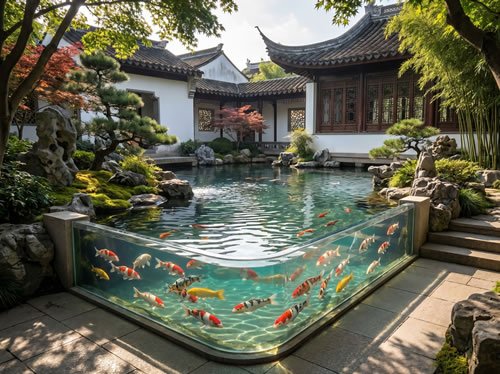
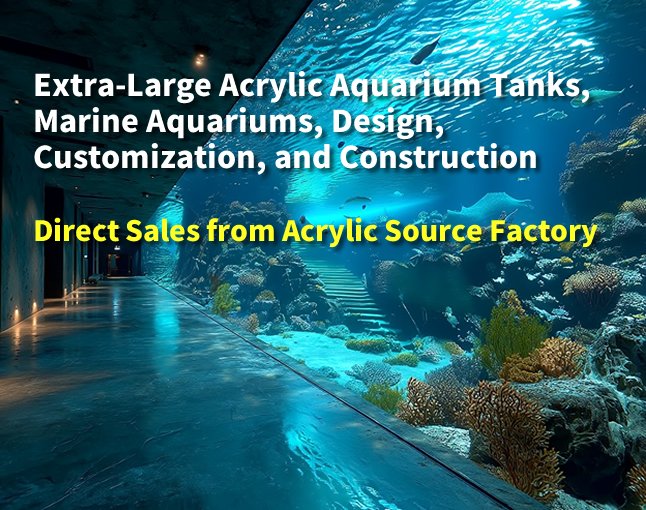
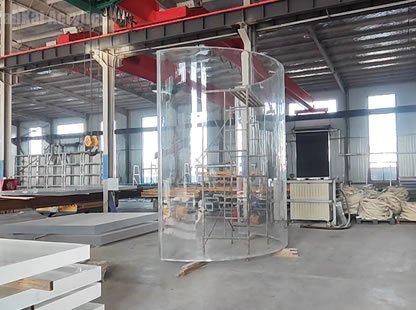
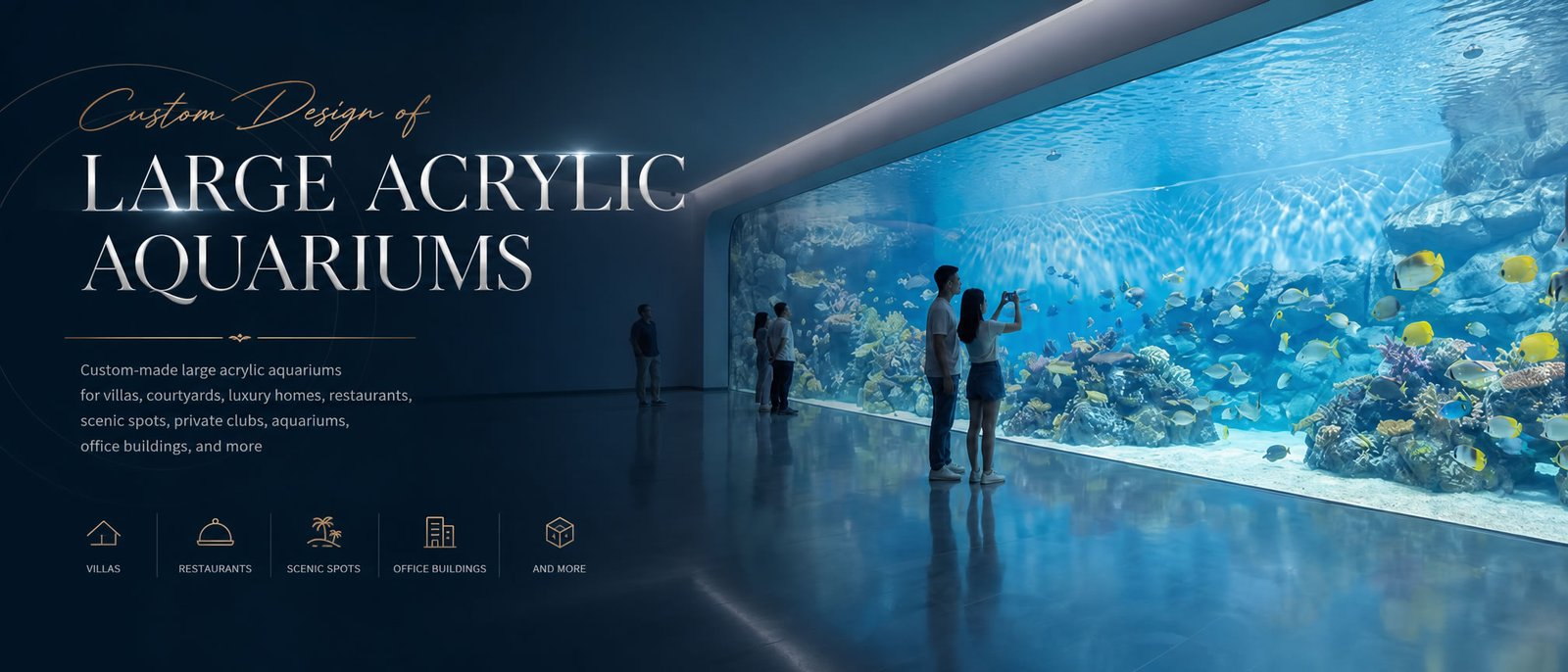
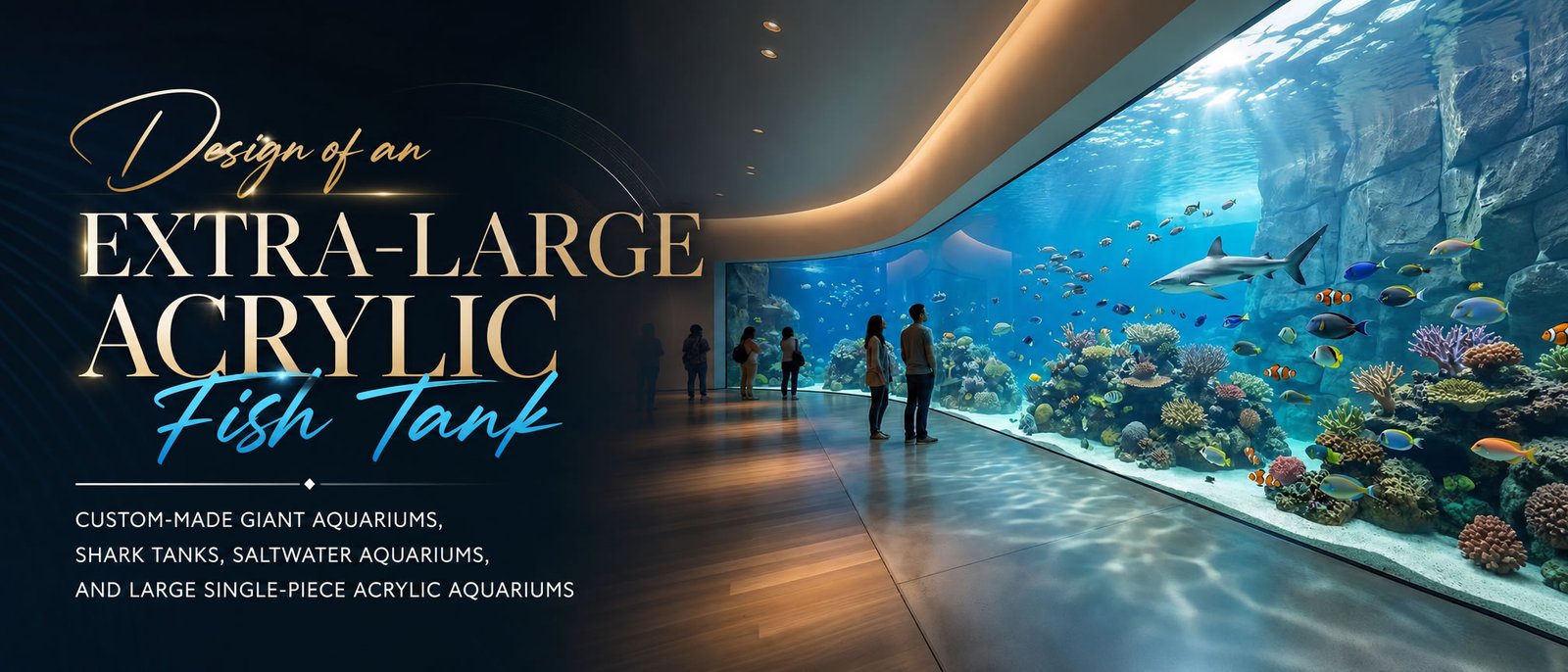
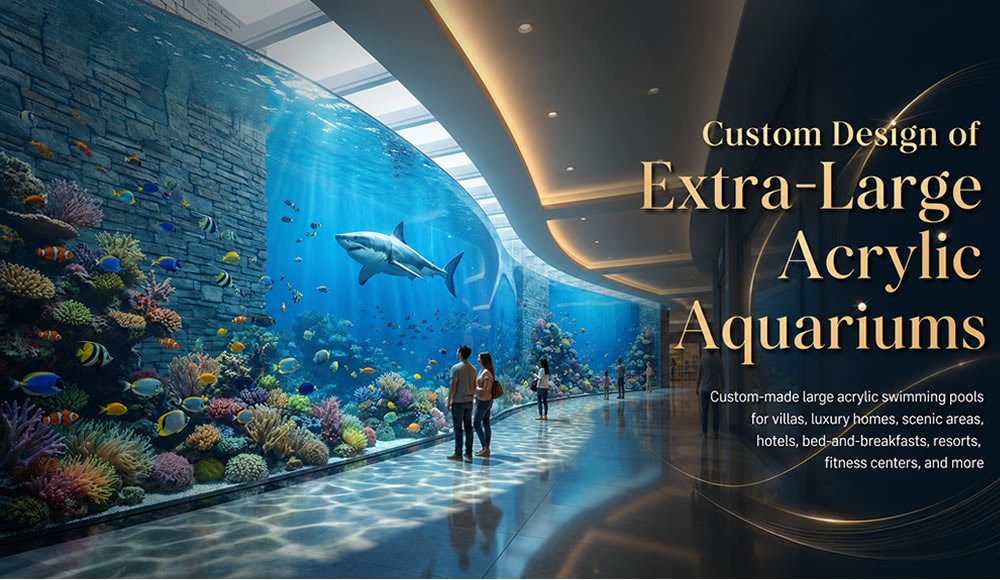
A massive acrylic tank—15 meters high, 8 meters wide, transparent on both sides, and 30 centimeters thick—stands right in the center of this five-star hotel’s lobby. It is not merely an aquarium; it is a frozen spatial totem.
I. The Giant Aquarium: The “Liquid Calling Card” of a Five-Star Hotel
For a five-star hotel, the lobby is the first statement of the brand’s prestige. And a giant acrylic fish tank is redefining the depth of that statement.
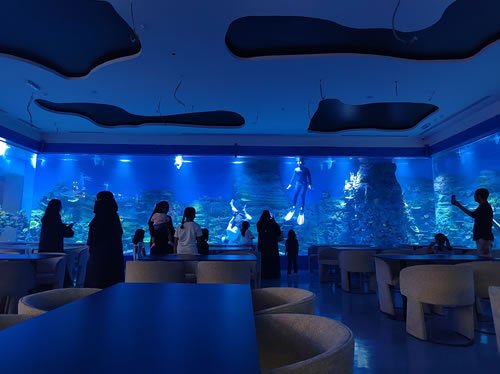
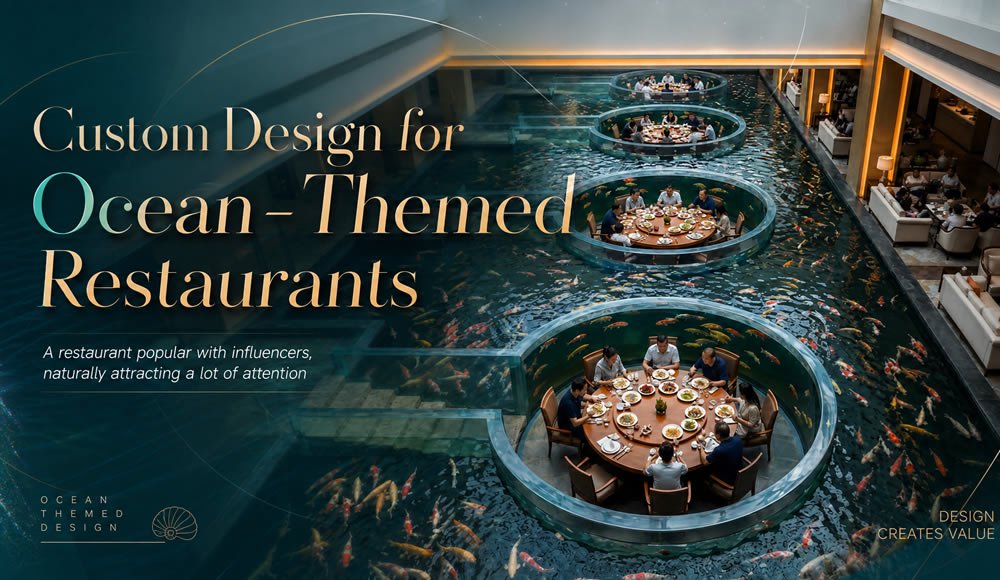
A visually stunning, irreplaceable “first impression.” In commercial spaces, a giant acrylic fish tank with sleek lines and crystal-clear transparency often becomes the first spot where guests stop to take photos and check in. Measuring 15 meters high and 8 meters wide, with a transparent design on both sides, it allows guests to admire the graceful movements of the fish from every angle—whether they’re entering the lobby, sitting in the lounge, or heading toward the elevators. This 360-degree, immersive experience—with no blind spots—is something no mural, sculpture, or lighting installation can provide.
Brand premium: defining luxury as “irreplicable.” While an ordinary five-star hotel can easily replace furniture or reupholster carpets, a massive aquarium integrated into the building’s structure becomes an immovable, irreplicable core asset once completed. World-renowned luxury hotels, from Atlantis in Dubai to the Radisson Blu in Berlin, all feature massive aquariums as their visual brand icons. This 15-meter-tall aquarium is precisely what sets this hotel apart from its competitors—it elevates the hotel from a mere “place to stay” to a “destination worth traveling to specifically.”
Spatial Narrative: Bringing Nature into the Urban Sanctuary. The most immediate value of a large aquarium is its ability to infuse the architecture with the vibrant beauty of nature, breaking away from the stiffness of traditional buildings. The 15-meter-tall body of water resembles a vertical ocean, with schools of fish gliding through it and light and shadow dancing on the rippling surface. This dynamic, ever-evolving natural landscape imbues the cold architectural space with breath and a pulse. As guests sit in the lobby bar, sipping a cup of coffee while gazing at the azure expanse, their fatigue is soothed in silence.
Empowered by Feng Shui: Water symbolizes wealth; circles symbolize harmony. In the design philosophy of luxury hotels, Feng Shui has always played a central role. According to traditional Feng Shui principles, water represents wealth; the circulation of water creates an “living water” energy field, and the colorful schools of fish swimming through it symbolize vibrant vitality and an endless flow of prosperity. A massive 15-meter-tall aquarium spanning the lobby space resembles a pearl radiating vitality from bottom to top, infusing the hotel with an endless flow of auspicious energy.
A unique experience that transforms “staying at a hotel” into “visiting an aquarium.” For guests of five-star hotels, comfortable bedding and exquisite dining are already standard features; what truly impresses them are “unexpected experiences.” A 15-meter-tall, double-sided transparent aquarium transforms every trip through the lobby into a mini-ocean adventure. This experience itself serves as the hotel’s most powerful word-of-mouth marketing tool.

II. 30 Centimeters: Why It’s a “Must” Rather Than an “Option”
15 meters high, 8 meters wide, and transparent on both sides—when taken together, these three figures place demands on the materials that go beyond the boundaries of conventional engineering. A thickness of 30 centimeters is not a “bold vision” of the designer, but rather the “minimum requirement” dictated by the laws of physics.
Water pressure: an invisible giant hand weighing ten thousand metric tons. Water pressure increases linearly with depth, following the formula P = ρgh. At a depth of 15 meters, the water pressure at the bottom reaches approximately 147 kilopascals per square meter—equivalent to a 15-metric-ton weight pressing down on an area the size of a school desk. Such immense, sustained pressure requires the panels to possess extremely high flexural strength and structural rigidity. A thickness of 30 centimeters is precisely the necessary dimension to withstand this 10,000-metric-ton giant hand.
Acrylic vs. Glass: A Contest with No Surprises. Some might ask: Why not use glass? The answer lies in glass’s “brittleness,” which is its fatal flaw. Under immense water pressure, if glass develops even a micro-crack or suffers an unexpected impact, it can shatter instantly, with catastrophic consequences. Acrylic, on the other hand, is more than 16 times more impact-resistant than ordinary glass; even if damaged, it will only develop blunt-edged cracks, rather than the sharp shards typical of glass. More importantly, acrylic possesses a certain degree of flexibility, allowing it to cushion water pressure through slight deformation, whereas glass can only “brace itself”—and if it can’t withstand the pressure, it shatters. Under extreme conditions at a depth of 15 meters, acrylic is the only choice that stands the test.
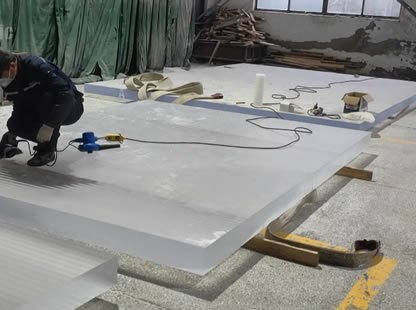
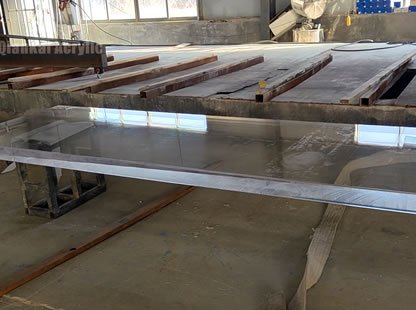
A 30-centimeter “Transparent Miracle.” The common perception is that the thicker the material, the more blurry it becomes. However, high-quality acrylic defies this assumption—even at a thickness of 30 centimeters, its light transmittance remains above 90%. The ultra-thick acrylic sheets produced by Shanghai Qiankai achieve a transparency of up to 93%, rivaling the luster of crystal. This means that visitors standing on either side of the giant tank can enjoy a clear viewing experience with virtually no visual distortion. This is a level of performance that no other transparent material can match.
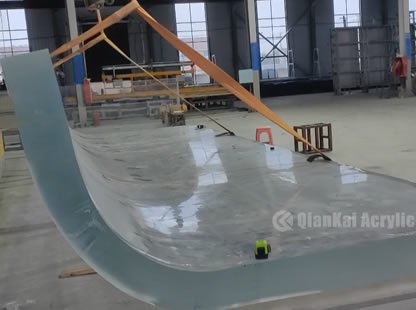
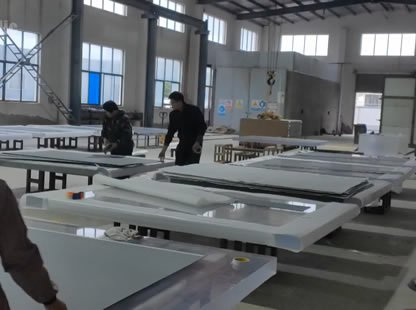
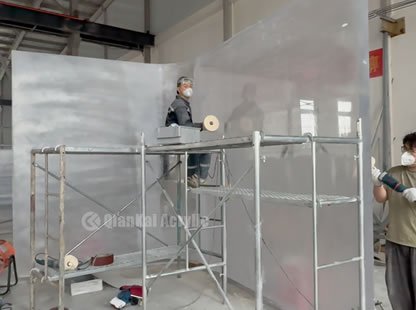
The Technical Challenges Behind 30 Centimeters. A 30-centimeter-thick acrylic sheet is far beyond the capabilities of an ordinary factory. It must be cast in a single pour using 100% high-purity acrylic raw material, undergoing more than thirty meticulous processing steps, including raw material purification, dust-free casting, constant-temperature curing, CNC cutting, thermal bending, mirror polishing, seamless splicing, and pressure testing. Processing precision reaches ±0.1 mm. A single oversight at any stage could render the entire sheet unusable. Globally, only a handful of companies are capable of consistently producing engineering-grade acrylic sheets exceeding 30 centimeters in thickness.
The challenge of a double-sided transparent structure. A single-sided viewing window already requires a thickness of 30 centimeters to ensure safety; double-sided transparency means both walls of the aquarium must withstand equal water pressure, and both viewing surfaces must maintain the same optical quality. This requires the sheet not only to be thick but also to maintain extremely low internal stress and exceptionally high optical uniformity despite its oversized dimensions. This is a hurdle that only top-tier engineering teams can overcome.
III. Qiankai Marine: The Company That Brings the Deep Sea into the Hall

Building such a massive aquarium requires not only a 30-centimeter-thick acrylic panel, but also a full-industry-chain service system spanning R&D, production, design, construction, and operation and maintenance.
Shanghai Qiankai Marine Engineering Co., Ltd. is precisely such a company.
As a comprehensive full-industry-chain service provider in China specializing in the high-end acrylic sector, Qiankai’s business encompasses R&D, production, custom processing, engineering design, construction and installation, and operations and maintenance services. The company focuses on three core sectors: marine cultural tourism, high-end aquariums, and viral transparent swimming pools. The company operates its own modern production base spanning over 50 mu, with an annual production capacity of more than 8,000 metric tons of acrylic sheets. It uses high-purity raw materials imported from the UK across its entire production line and strictly adheres to the ISO 9001 international quality management system.
In the field of ultra-thick acrylic sheets, Qiankai can customize any thickness ranging from 30 millimeters to a maximum of 2,000 millimeters. Leveraging multiple proprietary core technologies—including seamless splicing of thick sheets, thermal bending of large components, and specialized high-altitude installation—the company has successfully completed over 5,000 large-scale flagship projects. Its service network spans the globe, with products exported to the United States, Australia, Saudi Arabia, the United Arab Emirates, Southeast Asia, and other countries.
From solution planning, rendering design, panel production, and precision machining to construction and maintenance, Qiankai provides a fully integrated service. “Diving into the wisdom of the deep sea, awakening the spirit of the ocean”—this company, named “Qian” (meaning “to dive”), is using 30-centimeter-thick panels to steadily bring the grandeur and mystery of the deep sea into the lobbies of five-star hotels.
Conclusion

15 meters high, 8 meters wide, 30 centimeters thick, and transparent on both sides—behind these numbers lie rigorous calculations based on the laws of physics, groundbreaking advancements in materials science, precise collaboration in engineering ingenuity, and, above all, a five-star hotel’s profound understanding of the concept of “luxury.”
True luxury has never been about a gilded display of opulence, but rather the unseen craftsmanship—the 10,000 metric tons of water pressure borne by a 30-centimeter-thick structure, the precision engineering behind a 93% light transmittance, and Qiankai Ocean’s extraordinary ability to bring the deep sea into an urban sanctuary.
When a guest stands on one side of the giant tank and watches schools of fish glide leisurely by on the other, what they see is not merely the azure blue of the ocean, but also the grandeur of a hotel, the prowess of an engineering firm, and an era’s unwavering pursuit of ultimate aesthetics.









 Optimized by Seraphinite Accelerator