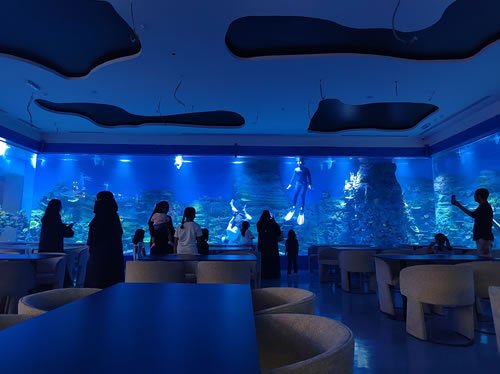













When you stand in front of that massive transparent viewing pane at an aquarium, watching sharks glide leisurely overhead, have you ever wondered why this seemingly lightweight “transparent wall” is as thick as 130 millimeters—or even thicker?
130 millimeters is equivalent to the width of an adult’s palm. For a transparent viewing window, this figure may seem a bit “excessive.” Yet it is precisely this 130-millimeter thickness that withstands the pressure of tens of metric tons of water, safeguards the safety of tens of millions of visitors, and creates the visual marvel of large acrylic aquariums.
I. Why Acrylic, Not Glass?
In large-scale aquarium projects, the choice of materials is never a simple matter. Although ordinary glass is ubiquitous in daily life, its limitations become glaringly apparent when an aquarium exceeds one meter in height and contains several metric tons of water.
Acrylic (chemically known as polymethyl methacrylate, commonly called plexiglass) has become the material of choice for large aquariums due to its unparalleled physical properties. At the same thickness, acrylic’s impact resistance is 16 to 17 times that of ordinary glass. This means that while a glass panel might shatter instantly under immense water pressure, acrylic—thanks to its unique flexibility—can cushion and disperse the pressure through slight deformation rather than fracturing brittle.
Even more remarkable is that even at thicknesses of 130 millimeters or more, acrylic maintains a light transmittance of over 90 percent. In contrast, glass exhibits noticeable visual distortion and a decrease in light transmittance as its thickness increases. It is precisely this quality of being “thick yet clear” that makes acrylic the ideal medium for connecting humans to the underwater world.

II. Water Pressure—The Invisible “Hand of a Giant”
To understand why a thickness of 130 millimeters is necessary, we must first grasp the power of water pressure.
Water pressure increases linearly with depth; for every 10-meter increase in water depth, the pressure rises by approximately 1 atmosphere. For a large aquarium 10 meters deep, the bottom must withstand a pressure of about 100 metric tons per square meter. At the bottom of a 15-meter-deep aquarium, this figure rises to as high as 150 metric tons—equivalent to 75 passenger cars pressing down on an area of one square meter.
Such immense pressure is far beyond what ordinary materials can withstand. The panel thickness of large aquariums must be strictly calculated based on water depth and tank span. Common thicknesses for large tanks range from 50 millimeters to over 200 millimeters, with 130 millimeters being a typical value within this range—it is sufficient to withstand the sustained high pressure generated by several meters of water depth while allowing ample safety margin.
III. A Precise Balance Between Safety and Aesthetics
The 130-millimeter thickness is not an arbitrary figure, but rather the result of mechanical calculations, materials science, and engineering experience working in concert.
When designing large acrylic aquariums, engineers must comprehensively calculate the panel thickness based on water depth, structural span, support methods, and long-term operating conditions. If the thickness is too thin, the tank may deform or even burst under immense water pressure; if it is too thick, costs and installation difficulty will increase significantly.
The concept of a safety factor is crucial here. Just as bridge designs must exceed actual loads by a wide margin, the acrylic viewing panels of large aquariums must also incorporate a substantial safety margin based on theoretical calculations. Industry standards typically require a safety factor of at least 8 times for viewing panels in large marine aquariums. The 130-millimeter thickness embodies this “safety first” design philosophy—it ensures the viewing panel’s load-bearing capacity far exceeds actual requirements, guaranteeing absolute reliability over the long term.
At the same time, a thickness of 130 millimeters strikes the perfect balance for the visual experience. At this thickness, the acrylic panel maintains extremely high transparency, allowing viewers to clearly see every detail underwater, while also effectively withstanding external impacts and preventing the aquarium from shattering due to accidental collisions.

IV. 130 Millimeters in Engineering Practice
The 130-millimeter thickness has been conclusively validated in real-world aquarium engineering projects.
The acrylic tunnel aquarium at Lanzhou Center Underwater World features a central cylindrical tank with a diameter of 10 meters and a height of 10 meters, holding 1,000 cubic meters of water. In this grand project, the main tank utilizes 200-millimeter-thick acrylic panels, while the walls of the internal tunnel viewing area are precisely 130 millimeters thick. These 130-millimeter-thick acrylic walls bear the pressure of 1,000 cubic meters of seawater, allowing visitors to experience up-close encounters with sharks and stingrays in a 360-degree transparent tunnel.
From a broader perspective, acrylic sheets ranging from 100 to 200 millimeters in thickness are the standard configuration for large commercial aquariums. At 130 millimeters—midway within this range—the material ensures sufficient structural strength while balancing manufacturability and cost-effectiveness—a perfect example of the “just right” wisdom in engineering.
V. The Technical Challenges Behind Ultra-Thick Sheets
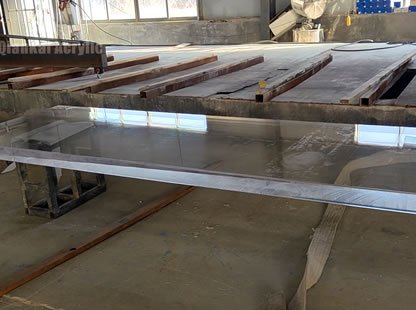
A 130-millimeter-thick acrylic sheet may seem like nothing more than a “thick piece of plastic,” but its production is an engineering feat with high technical barriers.
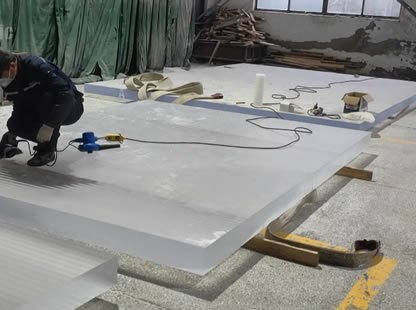
Such ultra-thick sheets cannot be produced using conventional extrusion processes; they must be manufactured through casting—where the raw material slowly polymerizes and cures within a temperature-controlled mold, a process that can take days or even weeks. Any temperature fluctuations or contamination during production can result in internal bubbles, uneven stress distribution, or reduced transparency. Globally, only a handful of companies are capable of consistently producing engineering-grade acrylic sheets exceeding 100 millimeters in thickness.
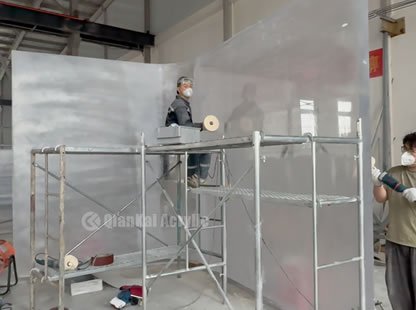
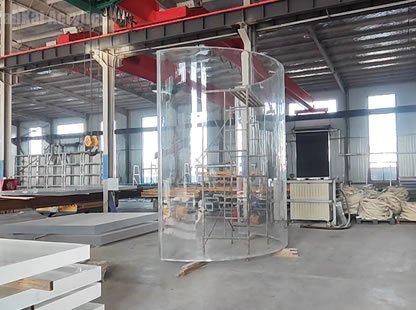
From sheet to aquarium viewing window, the material must undergo a series of precision processes, including high-temperature thermoforming, annealing to relieve internal stress, and molecular-level seamless splicing. Every 130-millimeter-thick acrylic viewing window represents the culmination of materials science, precision manufacturing, and structural engineering.










 Optimized by Seraphinite Accelerator